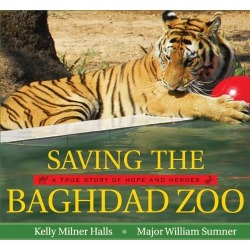
2010, Greenwillow/HarperCollins
Publishers Weekly, January 11, 2010
"This eye-opening tale of compassion and cooperation chronicles the mission of an international team of military personnel, zoo staffers, veterinarians, and relief workers to rescue neglected animals in Baghdad. Sumner, an army major who was deployed to Iraq in 2003 as a civil affairs officer, spearheaded the effort to round up the creatures from the heavily looted Baghdad Zoo, as well as a smaller nearby zoo and the abandoned palace of Saddam Hussein’s son. The animals all found new homes at the main zoo, which was extensively renovated and reopened to the public (“the opening was a sign of hope, a glimpse of normal life”). The collaborators detail several remarkable rescues, including the recovery of 16 rare purebred Arabian horses that had been stolen and hidden in a racetrack’s stables. Sidebars offering facts about various species, historical background, and Sumner’s emotional commentary supplement Halls’s (Dinosaur Parade) narrative, which doesn’t sidestep the ever-present danger. Sobering and uplifting photographs—many taken by Sumner—underscore both the direness of the situation and the spirit of hope that drove the project. Ages 8–up. (Feb.)
School Library Journal (June 2010)
Gr 5–8—War means bombs falling, buildings destroyed, humans fleeing to safety if they can. But what of zoo animals locked in their cages? As then U.S. Army Captain William Sumner was horrified to discover, they die from lack of food and water, they are butchered for human consumption, and they are stolen by dealers in exotic animals. Or, like those described in this book, they have grittily clung to life in appalling conditions. Asked by a commander to "look at a 'small' zoo" (actually, one of the largest in the Middle East), Sumner discovered a large one, plus three smaller "palace" zoos, and a number of other menageries. Animals were starving, thirsty, and unkempt. Volunteers miraculously appeared; support arose; zoological societies, veterinarians, and international wildlife groups offered aid and advice; and Sumner and his recruits got to work. This book chronicles their efforts—and the rehabilitation—of some of the zoo's residents. Saedia, a nearly blind brown bear who had never felt grass under her feet; Lumpy the camel, starved and dehydrated; and Saddam's personal pet cheetahs are just some of the creatures that appear in these poignant stories. Many color photos, some especially crisp or moving, document the efforts. While the Baghdad Zoo is no sterling example of what a modern zoological park ought to be, it is a shining example of human efforts to provide care and comfort to abandoned animals and to offer a sort of sanctuary to Iraqi residents whose lives have been drastically disrupted. Inspiring, yes, and a tad disturbing, but an important social record.—Patricia Manning, formerly at Eastchester Public Library, NY
Kirkus Reviews
Loaded with reader appeal, these tales of animal rescue focus on the animals but also provide some insight into what Baghdad was like in the wake of the U.S. invasion. Basing her account on numerous interviews-notably with co-author Sumner, then a Captain in the U.S. Army 354th Civil Affairs Brigade, who led international efforts to recapture and safely house wild animals held in the city's zoos-Halls tracks multiple forays into devastated areas in search of creatures that were often starving, thirsty and trapped in hideous conditions. Each outing presented different challenges, from a bear given so much alcohol by drunken zookeepers that it was immune to anesthetic darts to more than a dozen hugely valuable Arabian racehorses held in a compound guarded by probably armed thieves. That's not to mention the difficulties of transport past snipers, providing medical care and finding proper food for pelicans, lions, camels and others. The narrative downplays violence in favor of success stories; that upbeat tone and the many bright, engaging color photos will leave younger audiences more pleased than disturbed. (source notes; introduction and epilogue by the co-author) (Nonfiction. 10-12)
Booklist
Bolstered with large, beautiful color photos and informative sidebars, this dramatic picture-book-size photo-essay tells of the U.S. army rescue of zoo animals in the Iraqi war zone. The authors investigate what the rescue effort has done for the animals––including lions, tigers, dromedaries, bears, Arabian horses, tortoises, cheetahs, and more—as well as diplomacy, building bridges between the American military and the Iraqi people, especially the zoo workers. The rescue stories of human-animal bonding include close-up photos and facts. Archaeologist Sumner serves as a general in Iraq and is still active in protecting the zoo and its cultural heritage, and his first-person eyewitness accounts are woven in with Hall’s overview. Together, the authors address the continuing controversies: Why save the animals and not focus on the people? Why not return wild animals to their natural habitats? Many readers will be drawn into the debates about the ongoing role of the U.S. in Iraq. Grades 4-7. --Hazel Rochman
Horn Book
Animal enthusiasts will enjoy Saving the Baghdad Zoo: A True Story of Hope and Heroes by Kelly Milner Halls and Major William Sumner. Using fantastic photographs, humor, and heartwarming anecdotes, Halls and Sumner re-create the mission to rescue monkeys, dogs, lions, and many other animals while rebuilding the decimated Baghdad Zoo. Full of memorable animals like Lumpy the one-humped camel and Saedia the thirty-two-year-old brown bear, this book combines facts and narration into a moving story. (8–12 years)
New York Times,April 2010
During the 2003 invasion of Iraq, one of the many casualties in Baghdad was the city’s zoo. When United States troops arrived, they found only 32 of the original 500 animals alive, and most were starving. (The soldiers started by feeding them military-issue M.R.E.’s — Meals Ready to Eat.) The account of how the Iraqi zookeepers and Americans cooperated to bring the zoo back to life is hampered by cumbersome sidebars, but it’s a good story nonetheless.
A Year of Reading Blog
This is a great story. So often our kids come to the library looking for books about war. I am never sure quite what they want and neither are they. This book does not cover up the tragedies of a war, but doesn't focus on those. Instead this book focuseds on this one aspect of recovery and we get to know the real dangers, the real people and the animals who were involved. And Kelly Milner Halls definitely knows how to write for kids.
Smithsonian Asian Pacific American Center
Book Dragon
When I hear “collateral damage,” one thing I’ve never thought of before (I know, shame on me!) are the animals! And how much more tragic are the animals trapped in cages … like in zoos?
Here’s a wake-up call disguised as a children’s book … in times of war, what happens to the animals? Amazingly enough, many of the inhabitants of the Baghdad Zoo found an unlikely savior in an American soldier, Captain William Sumner (since promoted to Major), who was originally deployed to Iraq in 2003 as a civil affairs officer.
As a trained archeologist, Sumner arrived expecting to “work with the Iraqis to restore their cultural heritage.” Instead, he inherited the rescue of a “‘small zoo’ [which] turned out to be one of the largest zoos in the Middle East, plus three palace zoos and a number of other animal collections.”
To even softly utter that saving lives in wartime is a challenge is beyond understatement. But when those who need rescuing have four legs and don’t speak any languages you can readily understand, the challenge becomes infinitely more complicated. Veteran children’s author Kelly Milner Halls carefully captures Summer’s story of lions, tigers, and bears – oh my! – who along with a menagerie of other animals managed to survive the death and destruction all around them.
Whatever your stance on this seemingly neverending, incomprehensible “war on terror,” here’s a reminder to celebrate some of war’s most unexpected heroes.
Readers: Children, Middle Grade
Published: 2010
Educator/author Teri Lesesne
SAVING THE BAGHDAD ZOO: A TRUE STORY OF HOPE AND HEROES (Greenwillow, 2010) by Kelly Milner Halls and Major William Sumner is aptly titles. It is a story of hope: hope for the zoo animals whose habitats were destroyed by bombings in Irag. Goats, pelicans, lions, turtles, camels, and others were in danger of perishing for lack of shelter, food, water, and care. It is a story of heroes, too. Soldiers, like Sumner, who served on a team of veterinarians and zoologists determined to rescue the animals.
Photos, some taken by Sumner, accompany a text that is sobering and playful at turns. Call out boxes provide important details about the War in Iraq itself and stories about some of the occupants of the zoo (i.e., the bear that wouldn't sleep).
Here is a wonderful example of all that nonfiction can be: informative, entertaining, enlightening.
Weston Public Library
Saving the Baghdad Zoo tells the poignant stories of these remarkable animals. Meet the abandoned lions who roamed an empty palace with no food or drink; the camel, Lumpy, who survived transport through sniper fire; the tigers, Riley and Hope, who traveled 7,000 miles from home; and many more. Appropriate to animal lovers grades four and up.
Goodreads Librarian/Baltimore
This book is absolutely a must-have, no-discussion, gimme-gimme purchase for the school library....This team worked hard, improvised, begged, and above all, went far beyond the call of duty to feed and care for these creatures. It's a fascinating story, a terrific discussion starter, an inspiration.
Sacramento Book Review
It is an eye-opening and heart-breaking documentary of the post war collateral damage to the Baghdad Zoo....Together with Major William Sumner, Kelly Milner Halls had compiled various facts and anecdotes along with both heart-breaking and heart-warming photographs that carry us through the process of restoration. The re-opening of the Baghdad Zoo has become the oasis of hope to the people of Baghdad and around the globe.
War and Peace, Picture Book Style
by Colleen Mondor
2010 Cybil Award Nominee
2010 Nevada Reading Week List
2010 Parent's Choice Silver Award Honor Book -- read more about it HERE.
2010 VOYA Nonfiction Honor List
2010 Sasquatch Award Nominee
2014 Authors on Animals -- NPR Interview with Wes Sumner
"This eye-opening tale of compassion and cooperation chronicles the mission of an international team of military personnel, zoo staffers, veterinarians, and relief workers to rescue neglected animals in Baghdad. Sumner, an army major who was deployed to Iraq in 2003 as a civil affairs officer, spearheaded the effort to round up the creatures from the heavily looted Baghdad Zoo, as well as a smaller nearby zoo and the abandoned palace of Saddam Hussein’s son. The animals all found new homes at the main zoo, which was extensively renovated and reopened to the public (“the opening was a sign of hope, a glimpse of normal life”). The collaborators detail several remarkable rescues, including the recovery of 16 rare purebred Arabian horses that had been stolen and hidden in a racetrack’s stables. Sidebars offering facts about various species, historical background, and Sumner’s emotional commentary supplement Halls’s (Dinosaur Parade) narrative, which doesn’t sidestep the ever-present danger. Sobering and uplifting photographs—many taken by Sumner—underscore both the direness of the situation and the spirit of hope that drove the project. Ages 8–up. (Feb.)
School Library Journal (June 2010)
Gr 5–8—War means bombs falling, buildings destroyed, humans fleeing to safety if they can. But what of zoo animals locked in their cages? As then U.S. Army Captain William Sumner was horrified to discover, they die from lack of food and water, they are butchered for human consumption, and they are stolen by dealers in exotic animals. Or, like those described in this book, they have grittily clung to life in appalling conditions. Asked by a commander to "look at a 'small' zoo" (actually, one of the largest in the Middle East), Sumner discovered a large one, plus three smaller "palace" zoos, and a number of other menageries. Animals were starving, thirsty, and unkempt. Volunteers miraculously appeared; support arose; zoological societies, veterinarians, and international wildlife groups offered aid and advice; and Sumner and his recruits got to work. This book chronicles their efforts—and the rehabilitation—of some of the zoo's residents. Saedia, a nearly blind brown bear who had never felt grass under her feet; Lumpy the camel, starved and dehydrated; and Saddam's personal pet cheetahs are just some of the creatures that appear in these poignant stories. Many color photos, some especially crisp or moving, document the efforts. While the Baghdad Zoo is no sterling example of what a modern zoological park ought to be, it is a shining example of human efforts to provide care and comfort to abandoned animals and to offer a sort of sanctuary to Iraqi residents whose lives have been drastically disrupted. Inspiring, yes, and a tad disturbing, but an important social record.—Patricia Manning, formerly at Eastchester Public Library, NY
Kirkus Reviews
Loaded with reader appeal, these tales of animal rescue focus on the animals but also provide some insight into what Baghdad was like in the wake of the U.S. invasion. Basing her account on numerous interviews-notably with co-author Sumner, then a Captain in the U.S. Army 354th Civil Affairs Brigade, who led international efforts to recapture and safely house wild animals held in the city's zoos-Halls tracks multiple forays into devastated areas in search of creatures that were often starving, thirsty and trapped in hideous conditions. Each outing presented different challenges, from a bear given so much alcohol by drunken zookeepers that it was immune to anesthetic darts to more than a dozen hugely valuable Arabian racehorses held in a compound guarded by probably armed thieves. That's not to mention the difficulties of transport past snipers, providing medical care and finding proper food for pelicans, lions, camels and others. The narrative downplays violence in favor of success stories; that upbeat tone and the many bright, engaging color photos will leave younger audiences more pleased than disturbed. (source notes; introduction and epilogue by the co-author) (Nonfiction. 10-12)
Booklist
Bolstered with large, beautiful color photos and informative sidebars, this dramatic picture-book-size photo-essay tells of the U.S. army rescue of zoo animals in the Iraqi war zone. The authors investigate what the rescue effort has done for the animals––including lions, tigers, dromedaries, bears, Arabian horses, tortoises, cheetahs, and more—as well as diplomacy, building bridges between the American military and the Iraqi people, especially the zoo workers. The rescue stories of human-animal bonding include close-up photos and facts. Archaeologist Sumner serves as a general in Iraq and is still active in protecting the zoo and its cultural heritage, and his first-person eyewitness accounts are woven in with Hall’s overview. Together, the authors address the continuing controversies: Why save the animals and not focus on the people? Why not return wild animals to their natural habitats? Many readers will be drawn into the debates about the ongoing role of the U.S. in Iraq. Grades 4-7. --Hazel Rochman
Horn Book
Animal enthusiasts will enjoy Saving the Baghdad Zoo: A True Story of Hope and Heroes by Kelly Milner Halls and Major William Sumner. Using fantastic photographs, humor, and heartwarming anecdotes, Halls and Sumner re-create the mission to rescue monkeys, dogs, lions, and many other animals while rebuilding the decimated Baghdad Zoo. Full of memorable animals like Lumpy the one-humped camel and Saedia the thirty-two-year-old brown bear, this book combines facts and narration into a moving story. (8–12 years)
New York Times,April 2010
During the 2003 invasion of Iraq, one of the many casualties in Baghdad was the city’s zoo. When United States troops arrived, they found only 32 of the original 500 animals alive, and most were starving. (The soldiers started by feeding them military-issue M.R.E.’s — Meals Ready to Eat.) The account of how the Iraqi zookeepers and Americans cooperated to bring the zoo back to life is hampered by cumbersome sidebars, but it’s a good story nonetheless.
A Year of Reading Blog
This is a great story. So often our kids come to the library looking for books about war. I am never sure quite what they want and neither are they. This book does not cover up the tragedies of a war, but doesn't focus on those. Instead this book focuseds on this one aspect of recovery and we get to know the real dangers, the real people and the animals who were involved. And Kelly Milner Halls definitely knows how to write for kids.
Smithsonian Asian Pacific American Center
Book Dragon
When I hear “collateral damage,” one thing I’ve never thought of before (I know, shame on me!) are the animals! And how much more tragic are the animals trapped in cages … like in zoos?
Here’s a wake-up call disguised as a children’s book … in times of war, what happens to the animals? Amazingly enough, many of the inhabitants of the Baghdad Zoo found an unlikely savior in an American soldier, Captain William Sumner (since promoted to Major), who was originally deployed to Iraq in 2003 as a civil affairs officer.
As a trained archeologist, Sumner arrived expecting to “work with the Iraqis to restore their cultural heritage.” Instead, he inherited the rescue of a “‘small zoo’ [which] turned out to be one of the largest zoos in the Middle East, plus three palace zoos and a number of other animal collections.”
To even softly utter that saving lives in wartime is a challenge is beyond understatement. But when those who need rescuing have four legs and don’t speak any languages you can readily understand, the challenge becomes infinitely more complicated. Veteran children’s author Kelly Milner Halls carefully captures Summer’s story of lions, tigers, and bears – oh my! – who along with a menagerie of other animals managed to survive the death and destruction all around them.
Whatever your stance on this seemingly neverending, incomprehensible “war on terror,” here’s a reminder to celebrate some of war’s most unexpected heroes.
Readers: Children, Middle Grade
Published: 2010
Educator/author Teri Lesesne
SAVING THE BAGHDAD ZOO: A TRUE STORY OF HOPE AND HEROES (Greenwillow, 2010) by Kelly Milner Halls and Major William Sumner is aptly titles. It is a story of hope: hope for the zoo animals whose habitats were destroyed by bombings in Irag. Goats, pelicans, lions, turtles, camels, and others were in danger of perishing for lack of shelter, food, water, and care. It is a story of heroes, too. Soldiers, like Sumner, who served on a team of veterinarians and zoologists determined to rescue the animals.
Photos, some taken by Sumner, accompany a text that is sobering and playful at turns. Call out boxes provide important details about the War in Iraq itself and stories about some of the occupants of the zoo (i.e., the bear that wouldn't sleep).
Here is a wonderful example of all that nonfiction can be: informative, entertaining, enlightening.
Weston Public Library
Saving the Baghdad Zoo tells the poignant stories of these remarkable animals. Meet the abandoned lions who roamed an empty palace with no food or drink; the camel, Lumpy, who survived transport through sniper fire; the tigers, Riley and Hope, who traveled 7,000 miles from home; and many more. Appropriate to animal lovers grades four and up.
Goodreads Librarian/Baltimore
This book is absolutely a must-have, no-discussion, gimme-gimme purchase for the school library....This team worked hard, improvised, begged, and above all, went far beyond the call of duty to feed and care for these creatures. It's a fascinating story, a terrific discussion starter, an inspiration.
Sacramento Book Review
It is an eye-opening and heart-breaking documentary of the post war collateral damage to the Baghdad Zoo....Together with Major William Sumner, Kelly Milner Halls had compiled various facts and anecdotes along with both heart-breaking and heart-warming photographs that carry us through the process of restoration. The re-opening of the Baghdad Zoo has become the oasis of hope to the people of Baghdad and around the globe.
War and Peace, Picture Book Style
by Colleen Mondor
2010 Cybil Award Nominee
2010 Nevada Reading Week List
2010 Parent's Choice Silver Award Honor Book -- read more about it HERE.
2010 VOYA Nonfiction Honor List
2010 Sasquatch Award Nominee
2014 Authors on Animals -- NPR Interview with Wes Sumner

Left at the baghdad Zoo/The inlander
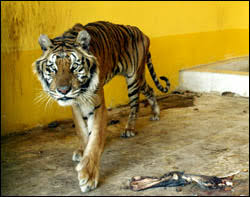
A Spokane writer has turned a soldier’s rescue efforts into children’s nonfiction.
By Tammy Marshall
“Why did you do this?” After months of recovery efforts in the aftermath of the 2003 American invasion of Iraq, a crowd of Iraqis gathered at the Baghdad Zoo are screaming at an American Army captain.
In a nearby cage, a tiger named Malooh — who had been born and lived his entire life at the zoo — lay dead from an American soldier’s gun. “It was terrible,” Captain William Sumner says. “One of the worst days of my life.”
Another soldier, possibly drunk, had stuck his arm in the cage, “trying to feed the tiger a kebab.” But Malooh clamped his jaws on the soldier’s arm and began shredding. Then came the gunshot. Months spent rehabilitating a creature that had already undergone so much pain lay wasted.
Sumner’s unit was first assigned to archiving the priceless relics of the Baghdad Archaeological Museum. But all that changed when Sumner’s commanding officer suggested that they check out a small abandoned zoo. That “small” zoo turned out to be one that was once the largest zoo in the Middle East.
When Sumner stepped through the metal gates embossed with the profile of a tiger, he discovered that out of 500 animals that once lived at the Baghdad Zoo, only 32 remained. The zoo workers were gone. Caged animals were alone in their cells, lying in their own waste and at the point of starvation. After seeing the devastation these animals were enduring, Sumner didn’t just think about doing something — he knew he had to do something. “Once I made the decision to rebuild the zoo, I never looked back on any other option,” he says.
For awhile, it seemed that every good thing the unit had done for the zoo after its discovery and for the neighboring war-torn Baghdad had been eroded by the reckless act of a single American soldier.
Years later and back in the States with his family, Sumner — now promoted to major — felt that his experiences at the Baghdad Zoo were tales only his young daughters and relatives would listen to.
But Spokane resident and children’s author Kelly Milner Halls had called Sumner to interview him about another topic: his rescue efforts centering on the recovered Arabian horses once owned by Saddam Hussein and worth millions of dollars. Sumner had led the rescue of the beautiful horses, said to possess the purest Arabian bloodlines in existence.
“You know it was more than just horses,” Major Sumner told Milner Halls at one point. “There was a zoo.”
Milner Halls didn’t even know that Baghdad had a zoo. But after that first interview, she and Sumner worked together to create a 64-page children’s book titled Saving the Baghdad Zoo. It tells the stories of Malooh, of a camel named Lumpy, of an alcohol-addicted bear, and of a slew of other animals rescued by the combined efforts of the coalition forces and Iraqi civilians.
Even though the book is aimed at children, Milner Halls and Sumner left out few details of the tragedy. “I was hugely affected by the death of the tiger and the bear,” Milner Halls says. “Both were tough to tackle for young readers. But I think we found a balance while still telling the truth.”
The book’s first printing of 25,000 was gone two weeks after it was released in February; it’s already in its second printing. Hollywood is looking into making a movie. And Milner Halls is now doing a book tour, sharing with young readers the sad circumstances of the zoo’s animals — along with how now the Baghdad Zoo has been rebuilt. Today, it stands as a flourishing symbol of hope for many Baghdad citizens.
And Major Sumner had thought that the story of the Baghdad Zoo wasn’t particularly worth preserving.
Kelly Milner Halls presents Saving the Baghdad Zoo – and authors Chris Crutcher, Terry Davis and Claire Rudolf Murphy present their books on Tuesday, April 27, at 7 pm at Auntie’s Bookstore, 402 W. Main Ave. Free. Visit auntiesbooks.com or call 838-0206.
https://www.inlander.com/spokane/left-at-the-baghdad-zoo/Content?oid=2131172
By Tammy Marshall
“Why did you do this?” After months of recovery efforts in the aftermath of the 2003 American invasion of Iraq, a crowd of Iraqis gathered at the Baghdad Zoo are screaming at an American Army captain.
In a nearby cage, a tiger named Malooh — who had been born and lived his entire life at the zoo — lay dead from an American soldier’s gun. “It was terrible,” Captain William Sumner says. “One of the worst days of my life.”
Another soldier, possibly drunk, had stuck his arm in the cage, “trying to feed the tiger a kebab.” But Malooh clamped his jaws on the soldier’s arm and began shredding. Then came the gunshot. Months spent rehabilitating a creature that had already undergone so much pain lay wasted.
Sumner’s unit was first assigned to archiving the priceless relics of the Baghdad Archaeological Museum. But all that changed when Sumner’s commanding officer suggested that they check out a small abandoned zoo. That “small” zoo turned out to be one that was once the largest zoo in the Middle East.
When Sumner stepped through the metal gates embossed with the profile of a tiger, he discovered that out of 500 animals that once lived at the Baghdad Zoo, only 32 remained. The zoo workers were gone. Caged animals were alone in their cells, lying in their own waste and at the point of starvation. After seeing the devastation these animals were enduring, Sumner didn’t just think about doing something — he knew he had to do something. “Once I made the decision to rebuild the zoo, I never looked back on any other option,” he says.
For awhile, it seemed that every good thing the unit had done for the zoo after its discovery and for the neighboring war-torn Baghdad had been eroded by the reckless act of a single American soldier.
Years later and back in the States with his family, Sumner — now promoted to major — felt that his experiences at the Baghdad Zoo were tales only his young daughters and relatives would listen to.
But Spokane resident and children’s author Kelly Milner Halls had called Sumner to interview him about another topic: his rescue efforts centering on the recovered Arabian horses once owned by Saddam Hussein and worth millions of dollars. Sumner had led the rescue of the beautiful horses, said to possess the purest Arabian bloodlines in existence.
“You know it was more than just horses,” Major Sumner told Milner Halls at one point. “There was a zoo.”
Milner Halls didn’t even know that Baghdad had a zoo. But after that first interview, she and Sumner worked together to create a 64-page children’s book titled Saving the Baghdad Zoo. It tells the stories of Malooh, of a camel named Lumpy, of an alcohol-addicted bear, and of a slew of other animals rescued by the combined efforts of the coalition forces and Iraqi civilians.
Even though the book is aimed at children, Milner Halls and Sumner left out few details of the tragedy. “I was hugely affected by the death of the tiger and the bear,” Milner Halls says. “Both were tough to tackle for young readers. But I think we found a balance while still telling the truth.”
The book’s first printing of 25,000 was gone two weeks after it was released in February; it’s already in its second printing. Hollywood is looking into making a movie. And Milner Halls is now doing a book tour, sharing with young readers the sad circumstances of the zoo’s animals — along with how now the Baghdad Zoo has been rebuilt. Today, it stands as a flourishing symbol of hope for many Baghdad citizens.
And Major Sumner had thought that the story of the Baghdad Zoo wasn’t particularly worth preserving.
Kelly Milner Halls presents Saving the Baghdad Zoo – and authors Chris Crutcher, Terry Davis and Claire Rudolf Murphy present their books on Tuesday, April 27, at 7 pm at Auntie’s Bookstore, 402 W. Main Ave. Free. Visit auntiesbooks.com or call 838-0206.
https://www.inlander.com/spokane/left-at-the-baghdad-zoo/Content?oid=2131172